

Friends,
Today is our first Solidarity Spotlight post, and I am so excited to share with you author Kat Armas’s new book, Liturgies for Resisting Empire.
Kat is not only an incredible author, a mother and partner, and brilliant theologian, she is a dear friend. You can believe me when I tell you that Kat’s books are born of fierce fire, a heart for justice-creating in the world through words, stories, ideas, and community.
This is a book for our time, and a book for all times, because we have always been dealing with the effects of off-kilter power dynamics, of those who take more than they should, of those who oppress and restrain and colonize.
First, the cover of this book is gorgeous:
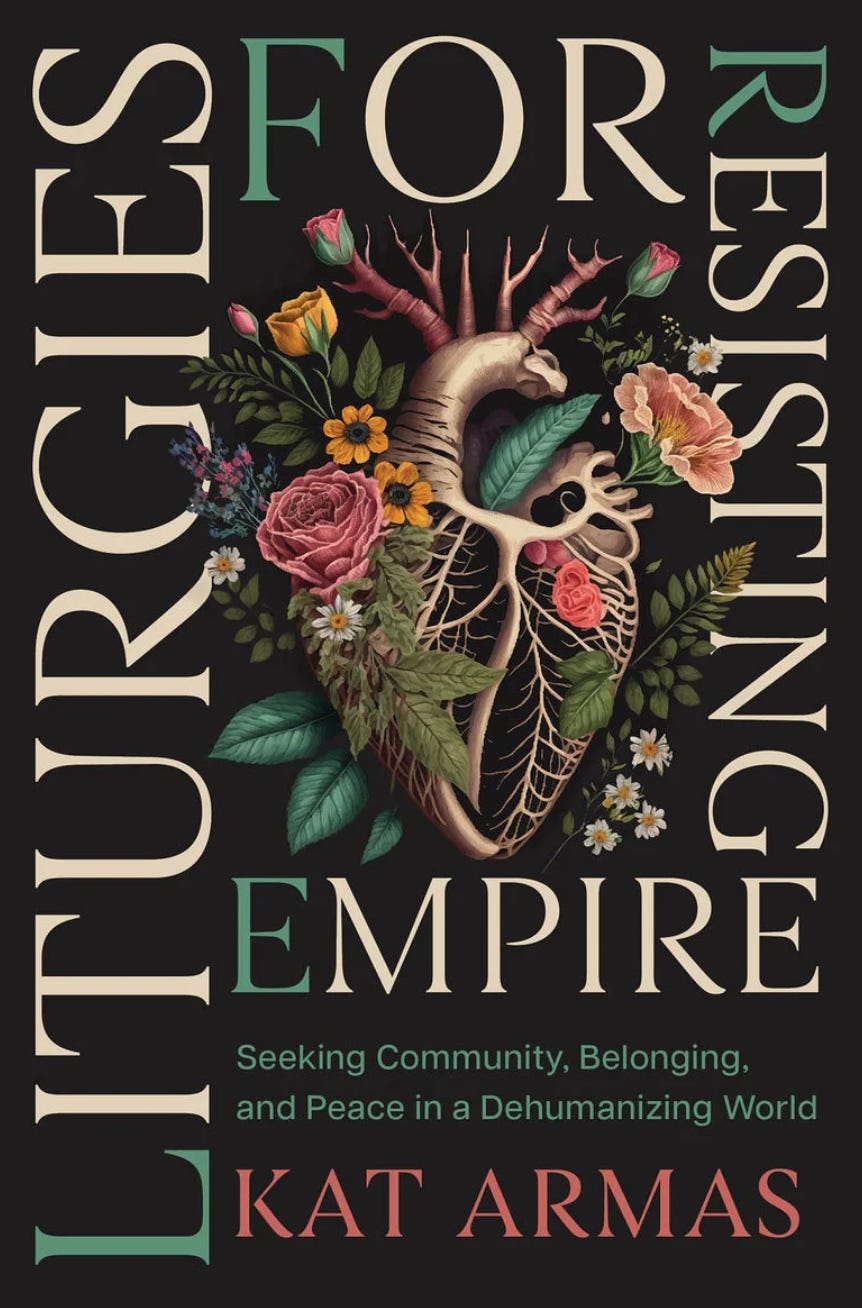
Second, you get a special treat-an excerpt of the book! Read the excerpt below, then go buy this book. We are in a critical moment in history. We need to educate ourselves on who we’ve been, who we are, and who we hope to become. We can do that by reading books by brilliant authors, like Kat.
Empires have always created their own ideologies in order to justify domination and control. These beliefs become systems of oppression over people and land alike. And in their wake, we are left with existential questions about identity and belonging that pierce the deepest parts of our being. Questions like “Who is my neighbor?” (Luke 10:29) and “My God, my God, why have you left me?” (Matt. 27:46). The answers to these questions are flesh and blood. They not only shape who we are, rippling through our lives, but also steer the course of history, which unfolds through the telling of stories. Stories are never innocent, never impartial. They carry the weight of perspective, ideology, and cultural values. Our stories are no exception. When we retell them, we do so from the lens of who we are today, with the knowledge and experience we hold in the moment. This means that our understanding of the past is colored by where we currently stand geographically, politically, and socially. We can never truly be objective, neutral observers. Because of this, there is no pure, unfiltered story; there’s only the truth we carry now. As I recall episodes from my childhood, I recognize the way my understanding of them shifts with time, with healing, with the slow revelation of what it means to belong to a family or a people. Each retelling is an act of interpretation, and in that act there is power.
To interpret our own stories is to reclaim something sacred, to perform an act of resistance. The interpreter becomes the storyteller, the one who shapes their own history. But to be colonized is to be stripped of that power; it is to be erased from one’s own story. This is part of empire’s violence: seizing control of interpretation, rewriting the past to impose its own narrative on people’s lives, land, and ancestors.
Biblical scholars have played a part in this erasure, reducing a text born in the heart of political and imperial struggle—a text that addresses economic, religious, and historical realities—to mere dogma. In doing so, they have ignored the imperial context and colonial dynamics that shaped the Bible’s origins, pretending they were never there. But the Bible in its entirety tells the story of empires—from Egypt to Assyria, Babylon, Persia, and Rome.
Exodus recounts the story of a people plucked from the grip of Egypt’s clenched fist. The story of the Israelites is a story of what it means to unlearn the rhythms of empire and learn how to walk as a people whose life and identity are free from oppression. As we move through the Hebrew scriptures, we hear the echoes of empire in so many places: from the prayers whispered in desperation to the defiant prophecies and the words of warning not to become the very thing they fled. The story of God’s people—from Moses to Daniel to Esther—is a story of empire. Every book of the Bible wrestles with what it means to exist within a context of imperial rule.
And yet, some treat the Bible as if it’s somehow untouched by politics, as if it’s concerned with only the spiritual and not these gritty realities. Most interpreters would have us believe that Jesus’s followers, for example, quietly accepted Roman authority and respected Rome’s rulers unless they were forced to choose between Christ and Caesar. But as we will see, this is far from the truth. Instead, many of the Bible’s letters and narratives are those of everyday people contending with, responding to, and critiquing empire in their day-to-day lives.
Content taken from Liturgies from Resisting Empire by Kat Armas, ©2025. Used by permission of Brazos Press.
Also, Kat has an amazing Substack, subscribe below and then go listen to the podcast she’s been releasing celebrating the book (there’s an episode in which I share about my new book, too, link below).
Your turn. In the comments, share:
Who is inspiring your right now?
What book is on your mind right now?
How do you foster imagination and hope under empire?
Friend, what an honor it is to do this work alongside you.
As I did with your new book, I pre-ordered Kat Armas' new one and my copy arrived on November 4. It's next on my list after I finish yours. I have read and retained her other books as I have yours.